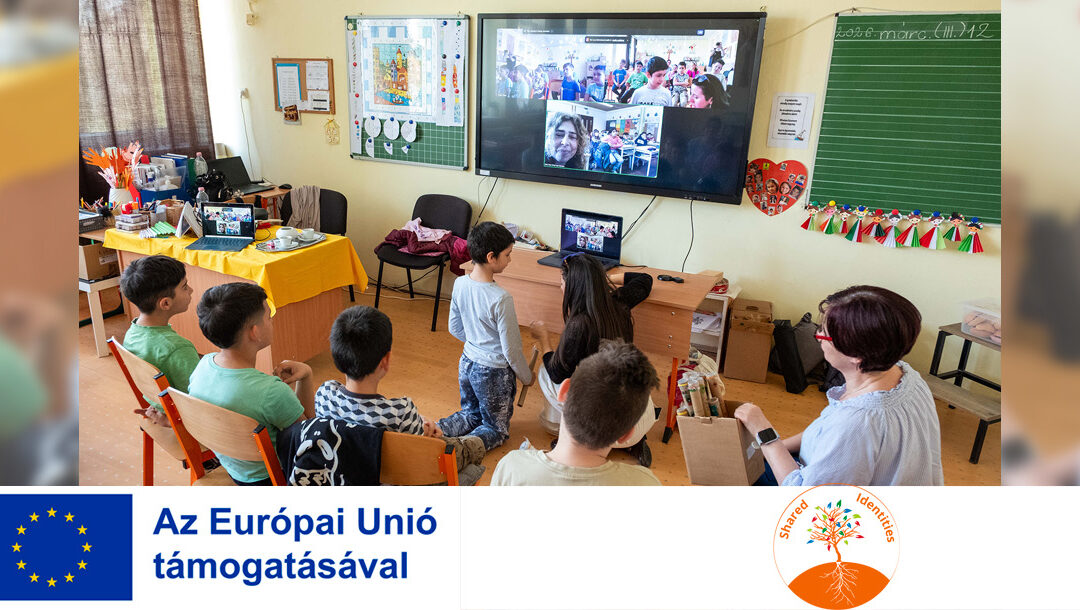
Exchanges between schools in different countries are one of the areas of focus for Shared Identities – Identidades Compartidas. The project, coordinated by MUS-E Hungría and developed in collaboration with MUS-E Alemania, the Associação Yehudi Menuhin Portugal and the Fundación Yehudi Menuhin España, it uses the arts to promote mutual understanding, intercultural communication, and the building of bonds among children from Hungary, Germany, Portugal, and Spain.
Among the experiences compiled and submitted by the Hungarian team at the end of the 2025–2026 school year were the first virtual exchanges between the MUS-E classes in Budapest and Zalaegerszeg and their partner groups in Évora. These sessions provided an opportunity to explore the themes “My Roots and Traditions” and “My Environment,” share creative processes, and develop trust, digital competence, and intercultural awareness. Here is how the Hungarian team describes the experience:
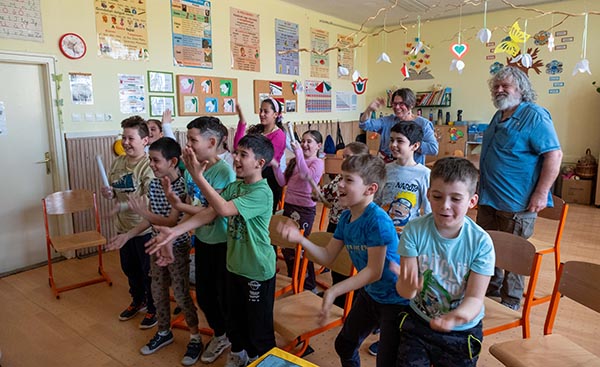
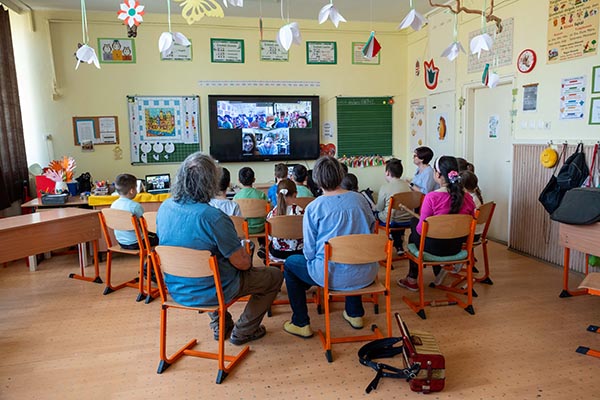
This spring, students from our MUS-E classes in Budapest and Zalaegerszeg connected with their partner classes in Évora, Portugal, during two online exchange sessions organized as part of the Shared Identities project.
For many children, this was their first opportunity to meet peers from another country. Although English was not the native language of either group, several people from both sides made an effort to introduce themselves and communicate in English, which made the encounters even more authentic and memorable.
The meetings also provided many children with new ways to connect. For some, it was their first experience with Zoom—seeing themselves projected on a large screen or participating in an international online meeting. The sessions were recorded, and the excitement of watching them later added another dimension to the experience.
Music became a natural bridge between the groups. During both meetings, the classes performed songs and shared samples of their creative work. The children from Hungary also presented projects they had developed around the first two themes of Shared Identities: “My Roots and Traditions” and “My Environment.” In this way, they gave their peers from Portugal a glimpse into their communities, traditions, and daily lives.
The Portuguese classes, in turn, presented their own activities and perspectives, allowing the children to discover similarities and differences through creative expression.
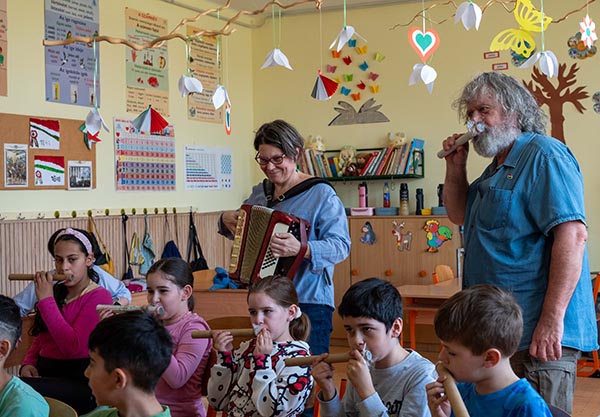
One of the initiatives took place in the Zalaegerszeg classroom, where the children created personalized paper horns as gifts for each of their classmates in Portugal. After the online exchange, these handmade instruments were mailed.
A few weeks later, during the project’s exchange in Évora, MUS-E artist Judit Hochrein had the opportunity to play the instruments alongside the children from Portugal, creating a tangible connection between the virtual meetings and the subsequent in-person international exchange.
These initial online meetings demonstrated that meaningful cross-cultural exchange does not require perfect language proficiency. Curiosity, creativity, and a willingness to communicate were enough to forge bonds between the children. The exchanges also contributed to the development of their self-confidence, digital literacy, and cross-cultural awareness.
The Shared Identities program is co-funded by the Programa Erasmus + de la Unión Europea.
The European Commission’s support for the production of this publication does not imply endorsement of its contents, for which the authors are solely responsible. Therefore, the Commission is not responsible for any use that may be made of the information contained herein.
Recent Comments